
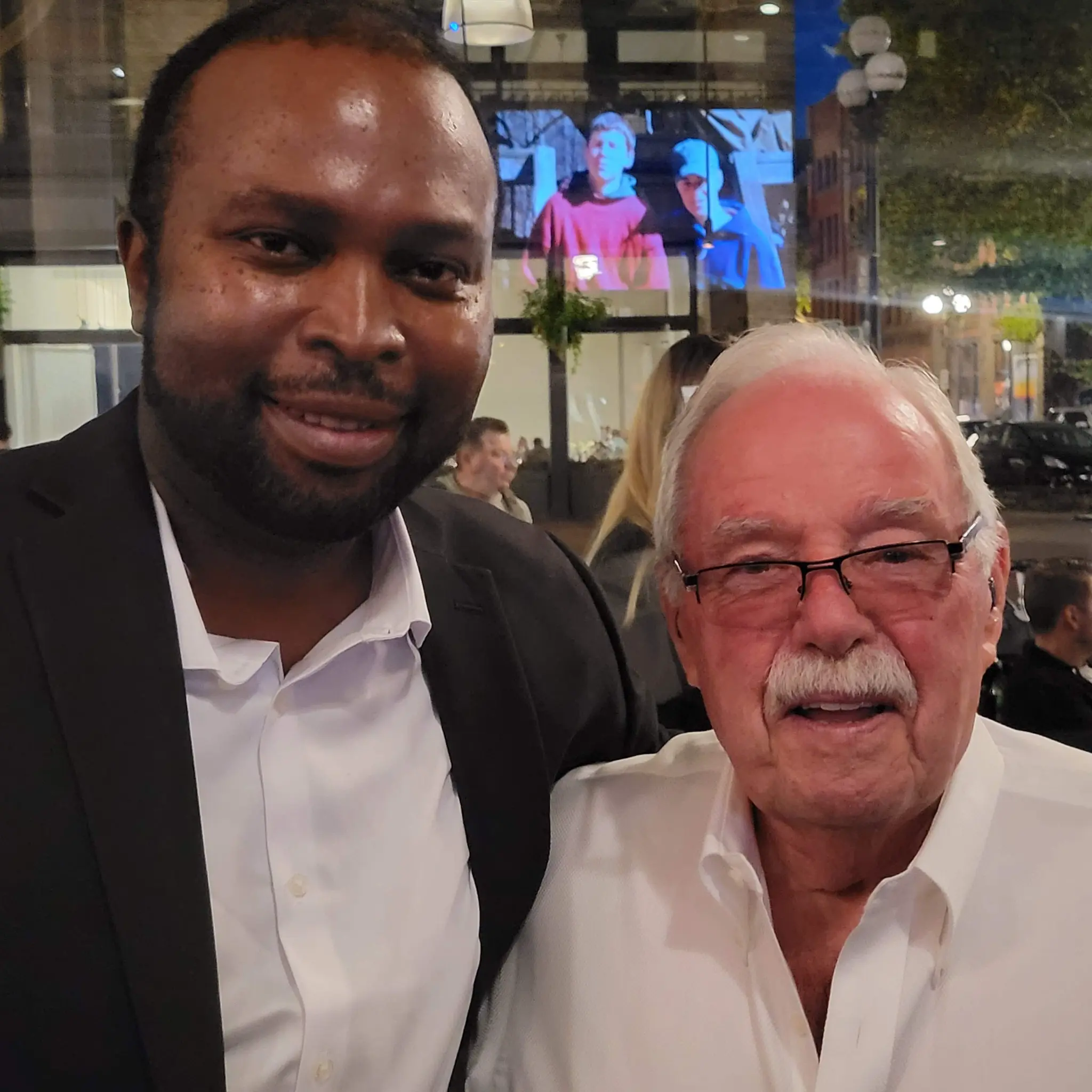
Some of the most important lessons are often dressed up in small moments, in conversations that feel almost accidental, at gatherings where the agenda was something else entirely.
I have known Jim Sinegal for a few years now. I have been friends with his daughter, Soozi Sinegal, and with her foundation, the Gashora Girls Academy of Science and Technology in Rwanda. If you are looking for a cause worth supporting, I would wholeheartedly recommend Gashora. Whenever I have had the chance to see Jim, I have tried to learn something from him. What has always struck me is that, for someone who built one of the greatest companies in the history of modern retail, he carries himself with extraordinary simplicity, the kind that comes from having seen enough to know what truly matters.
Recently, at the celebration of life of a close friend (who I consider a brother) who passed away from colon cancer, I saw him again in downtown Seattle.
It was one of those emotionally layered gatherings where grief, gratitude, memory, and perspective all sit in the same room together. In the middle of that, I saw Jim for the second time and decided to have a “School of Hard Knocks” moment.
So I asked him directly:
“Jim, what 2 or 3 nuggets would you give me for business success (he knows of Hurone)?”
He did not hesitate.
He said:
“First, love what you do. If you don’t love what you do, get the money, get the hell out, and find a business whose cause you love very passionately.”
Then he gave me the second:
“Second, have the grit to wade it out, because there will be waves, bad and good, but your ability to wade it out and never give up will bring you great success.”
It was classic Jim: plainspoken, direct, and impossible to misunderstand.
But the conversation did not stop there.
He also spoke about mentors, and surrounding oneself with the smartest and most passionate people to move the goals of your company forward.
And that part stayed with me just as much.
Jim’s own mentor was Sol Price, the legendary retailer behind FedMart and later Price Club, the company that pioneered the warehouse-club model that would eventually shape Costco. Jim has said in interviews that calling Sol merely an influence would be an understatement, that he learned essentially everything from him. Jim started young in retail at FedMart, where Sol Price’s philosophy shaped how he saw customers, value, operations, and fairness.
That matters because when people look at iconic founders, they often imagine them as self-made. I have always known that on a granular note, there is really nothing like true “self-made”, regardless of how much work we put into what we are building, people and connections at every step, every inflection point is critical for growth and success.
Before there was Costco, there was Sol Price. Before there was a giant public company admired for operational discipline and customer trust, there was a younger Jim learning under a master retailer who understood that a durable business is built on value, consistency, and respect for the customer and the people who serve them.
And then there is another part of the story Jim told, that I feel is probably the most important Ὅ grit in the face of major setback.
Jim narrated to me one of his big early setbacks. This was in 1988 when Costco’s move to the Midwest had all sorts of problems, and they had to pull back and refocus on the West and East Coasts. In other words, one of the most admired retail companies in America had a geographic expansion that did not initially succeed and had to be corrected.
That piece of the story is important and really resonated with me because of a similar issue we encountered at Hurone (click here to read the story).
Great companies do not become great because they avoid mistakes. They become great because they survive them, learn from them, and stay coherent and consistent enough to keep building.
That is what makes his two lessons fit together so well.
Love what you do.
Because if you do not, hardship, pain and suffering will eventually expose you.
Wade it out.
Because even if you do love it, hardship is still coming.
To me, those two principles are deeply relevant to what we are building at Hurone.
Healthcare is not a place for shallow conviction. Cancer care certainly is not. AI in healthcare is not a field where you can build on borrowed enthusiasm for very long. The work is too hard, the stakes are too high, and the trust required is too great. If you do not genuinely care about the problem, you will eventually choose comfort over endurance.
This conversation has stayed with me because it reminded me that building something enduring is rarely about brilliance alone. It is a culmination of grit, passion, surrounding oneself with smart and talented people, and more importantly with mentors.
“What an elder sees while sitting, a young person cannot see even while standing.”
African Proverb
Great read and very inspiring. Thank you, Kingsley!
This is a very helpful guide.
Very Inspiring.
Very inspiring article…
“Love what you do, because if you do not, hardship, pain, and suffering will eventually expose you” is such a powerful and fundamental principle for business success. It truly can make or mar anyone pursuing success in business, especially when challenges arise.
“Second, have the grit to wade it out, because there will be waves, bad and good, but your ability to wade it out and never give up will bring you great success.”
Great! I love this.
The best way to grow is to be around those older than you, fast lane on the right direction, such experiences won’t only build you it will equally motivate us
Truly, ” Healthcare is not a place for shallow conviction.”
Looking forward to more write ups from you Dr Kins
I love this!! Very inspiring